
How ADRF is Solving System Integrator’s Biggest Installation Challenges
The surge in demand for high-capacity wireless connectivity, as well as shifting mandates for public safety communications, is forcing building owners (and systems integrators by extension) to rethink infrastructure choices. Today’s wireless systems are being squeezed into telecom closets that are already operating at their physical limits.
Traditional DAS (distributed antenna system) architectures, with large head-end and remote units, standalone filtering equipment, and messy cabling frameworks, are no longer cutting it. They can be difficult to install, a nightmare to maintain, and contribute too much strain on facility power, which is becoming a bigger problem to manage with each passing day due to heavier reliance on AI.
A simplified installation isn’t just about convenience for integrators, but it’s a structural advantage that will shape long-term system performance. That is why we are continually innovating to make installation and maintenance better for commercial and public safety deployments.

Tackling Data Centers
For system integrators tasked with deploying these next-generation networks amidst other technologies, limited space and energy constraints are becoming major roadblocks to scalable, future-ready connectivity. Data centers highlight these roadblocks perhaps more than any other industry right now.
These facilities are facing an unprecedented energy and space crisis, driven heavily by AI workloads and massive data traffic. Every single inch of rack space and watt of power is strictly budgeted and integrators must look in every corner for savings.
For integrators working in data center environments, ADRF can replace fragmented legacy wireless hardware with enhanced design and features. For instance, ADRF’s converged wireless solutions, such as our ADXV Series DAS, can unify the network infrastructure needed for both commercial and public safety communications, combining the equipment, cabling, and enclosures used in ERCES (Emergency Responder Communication Enhancement Systems) and commercial in-building wireless systems. Another example is our PSR NEO Series repeater with a built-in Emergency Power Off (EPO) switch and integrated annunciator that can shrink the hardware footprint. Rather than requiring external add-ons that take up rack space, these public safety features are baked right into the unit. This integrated design allows remotes and frequency bands to be managed efficiently, and public safety elements to remain securely partitioned, lowering overall power consumption, reducing localized heat output, and ensuring code compliance.
Designing for the Integrator, Building for the Future
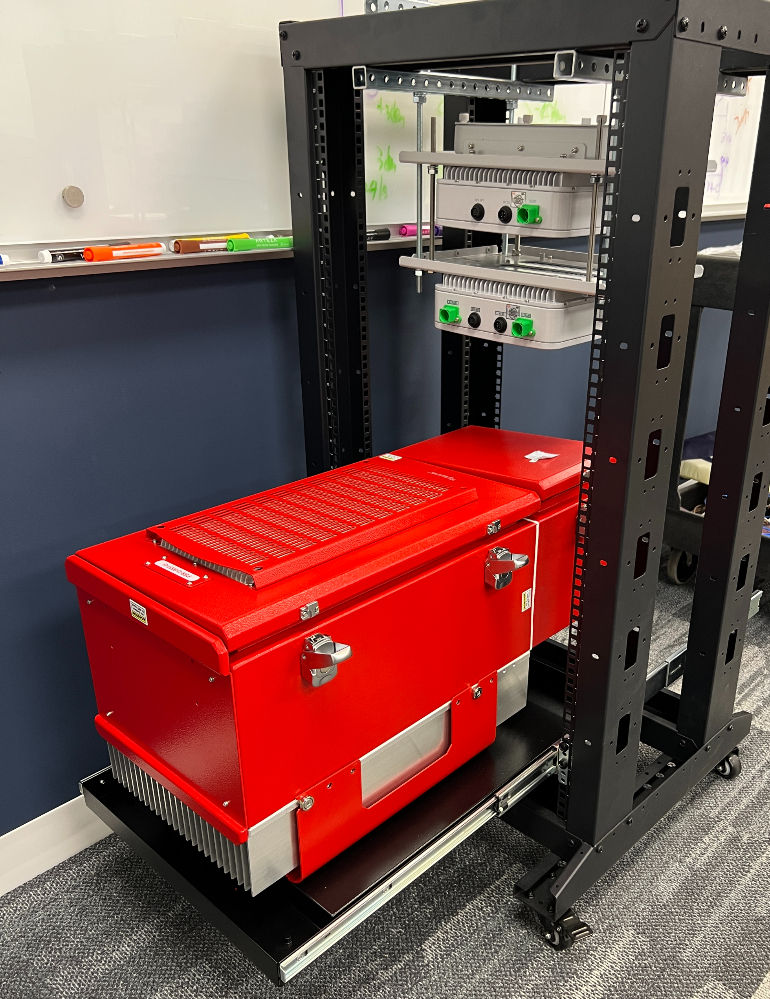
Every additional piece of hardware, loose cable, or rigid mount in a wireless deployment introduces operational risk. This is intensified when integrators have to wrestle with heavy, delicate RF equipment in small spaces. To directly solve this, ADRF introduced a sliding tray for 19” racks (ADRF-RMK-SA1).
Modern, high-capacity gear can be very heavy. This sliding rack mount is engineered to support a substantial amount of weight, ensuring that heavy-duty, high-performance equipment remains securely mounted without putting strain on the rack framework. Instead of reaching behind a rigid rack or having to unmount equipment just to check a connection, integrators can simply slide the piece of gear forward. This grants immediate, effortless access to the back and sides of the unit, drastically cutting down maintenance time and reducing operational complexity.
Our sliding tray also includes an active cooling fan, pulling heat away from dense hardware clusters, relieving the strain on the building's overall HVAC system and ensuring the equipment runs reliably, preventing post-installation troubleshooting calls for the integrator.
By focusing on new hardware that supports easy installation and maintenance, as well as reduces power and space burdens. ADRF is empowering integrators to do what they do best: build fast, reliable, and future-proof networks.
Want to learn more about how the ADRF’s PSR NEO Series or Rack Mount Sliding Tray can streamline your next deployment? Contact the ADRF team today!